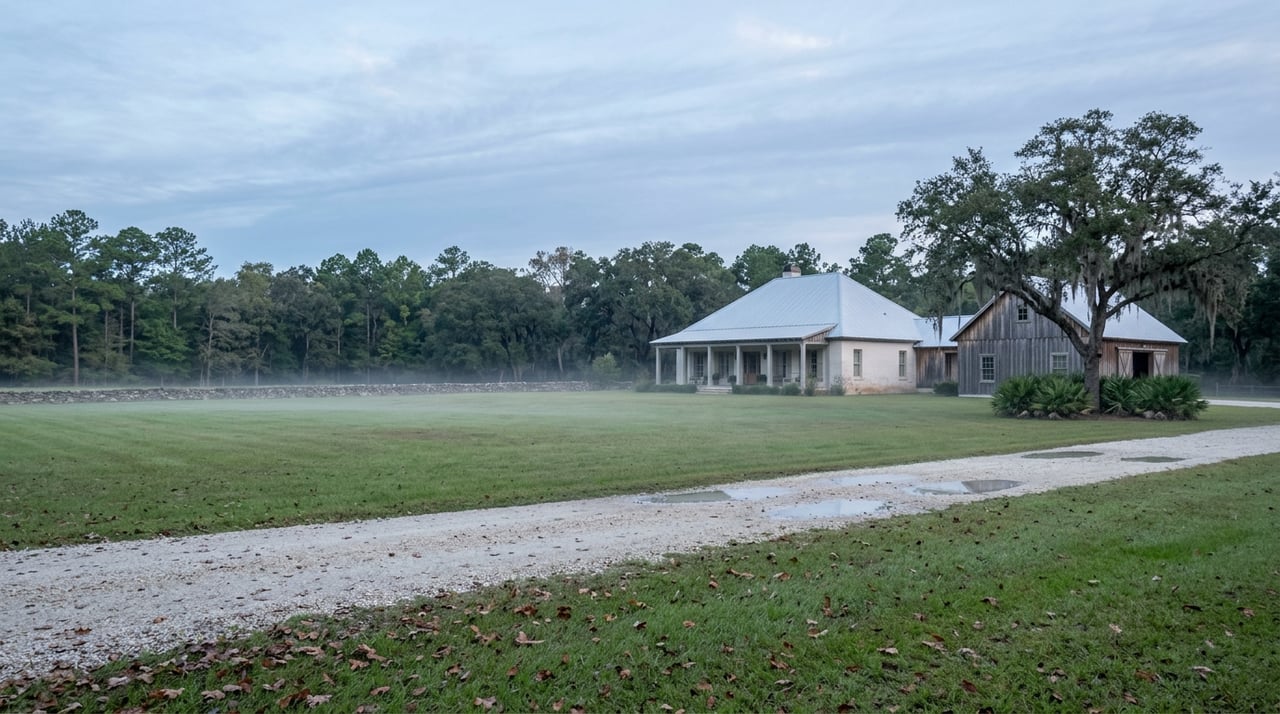
Ask most land buyers in St. Tammany Parish how acreage pricing works and they will tell you the same rule every appraiser learns early: the more acres in the tract, the lower the price per acre. Scale brings a discount. A five-acre lot near town costs more per acre than a fifty-acre tract further out, because infrastructure, road frontage, and buildable area get scarcer as parcels shrink.
Folsom's horse country does not follow that rule. Land there tends to sell in larger tracts than the parish average, and yet it commands a higher price per acre, not a lower one. If you are comparing a raw parcel outside Covington to an equestrian property in Folsom, the math you learned on the first search does not carry over. Here is what is actually happening, and why it matters if you are the kind of buyer who wants land that does something rather than land that simply sits.
The Rule Every Acreage Buyer Learns First
Across St. Tammany Parish, land currently for sale averages roughly $43,803 per acre, based on active listings tracked across the parish. That figure blends everything from small in-town lots to sprawling rural tracts, and it follows the pattern you would expect: as parcel size goes up, price per acre tends to go down. A buyer shopping generically for acreage in Covington, Madisonville, or Bush is largely negotiating against that curve. Bigger land, lower unit cost.
That is the baseline. It is also the number most buyers carry into their first conversation about Folsom, assuming the same discount will apply once they cross into horse country.
Where Folsom Breaks It
It does not. Equestrian property currently listed near Folsom averages about $56,766 per acre, with an average listing price around $680,000. That is roughly $13,000 more per acre than the parish-wide average for land in general, on parcels that are not small. The premium runs the opposite direction from what the standard land rule predicts.
The reason is not location alone. Folsom sits in the same rural stretch of the parish as much of the acreage that pulls the parish average down. What changes the math is what sits on top of the dirt, and what surrounds it.
What You're Actually Paying For
Raw acreage is a blank input. Equestrian acreage is a finished system, and the price reflects the difference. A serious horse property typically arrives with cross-fencing already built, pastures already established, a stable with stalls, wash racks, and tack storage, and often a second structure for staff, guests, or an apartment over the barn. Building that from scratch on raw land means months of permitting, fencing contractors, well or water line work, and barn construction before a horse ever sets foot on the property. Buying it pre-built compresses that timeline to a closing date.
Then there is the surrounding economy, which is easy to underweight until you are the one boarding a horse or hauling a trailer every weekend. Lagniappe Equestrian Center, a nearly 300-acre facility in Folsom, runs four riding arenas, a cross-country course, a 150-stall show barn, and both stall and pasture boarding. It hosts competitions that draw riders from outside the parish, including the Fleur De Leap Horse Trials, a USEF-recognized eventing competition scheduled for November 7 and 8, 2026 at the facility. A few miles away, Pony Power Folsom runs lessons for riders as young as four, building the kind of local instruction pipeline that keeps a horse community active rather than isolated.
None of that shows up in a soil survey or a plat map, and none of it will appear on a comparison chart built purely from acreage and price. But it is exactly what a buyer is purchasing when they pay the Folsom premium: proximity to a place their horse can compete, board, or train without a trailer ride to another parish, and a community of instructors, farriers, and fellow riders who already treat the area as a hub rather than a stop.
A Live Example on the Ground
An 85-acre equestrian estate currently on the market in Folsom illustrates the pattern at full scale. The property includes 55 acres of vinyl-fenced and cross-fenced pasture divided into twelve separate paddocks, a stocked lake with a fishing dock, and a lighted Ocala-style stable with fourteen stalls, four of them built for foaling. The stable carries its own one-bedroom apartment, tack and feed rooms, and a presentation space with a full kitchen for hosting. A separate 7,500 square-foot climate-controlled building handles vehicle storage. I represent this listing, and the specifics are worth walking through because they show exactly where the per-acre premium goes: not into the land itself, but into the systems built across it. Twelve fenced pastures instead of one open field. A working lake instead of a dry pond site. A stable wired, plumbed, and staffed-ready rather than a barn still on the drawing board.
Compare that to raw acreage elsewhere in the parish priced closer to the $43,803 average. That buyer gets more square footage of dirt for the dollar, but every piece of usable equestrian infrastructure still has to be designed, permitted, and built before the property functions the way this one already does.
The Math for a Buyer Comparing the Two
| Parish-wide land (average) | Folsom equestrian property (average) | |
|---|---|---|
| Price per acre | ~$43,803 | ~$56,766 |
| Typical average listing price | Varies widely by parcel | ~$680,000 |
| What's included | Raw or lightly improved land | Fencing, pastures, stable, often water and utility infrastructure already in place |
The roughly $13,000-per-acre gap is not padding. On an 85-acre property, that spread represents well over a million dollars in the difference between land priced as land and land priced as a finished equestrian operation. Whether that premium makes sense depends entirely on what the buyer intends to do with the property. Someone planning to build slowly over several years, choosing every fence line and stall layout themselves, may find raw acreage the better use of capital. Someone who wants to move horses in within weeks of closing, and who values being five minutes from a 300-acre event venue rather than an hour from the nearest boarding facility, is paying for time and access, not just for pasture.
That is the number worth carrying into a Folsom search: not the parish average, and not the equestrian average in isolation, but the gap between them. It tells you what infrastructure and location are actually worth in this specific pocket of the Northshore, and it should shape how you read every listing that follows.
If you are weighing raw acreage against an improved equestrian property in Folsom, or trying to figure out which side of that math makes sense for your plans, I would be glad to walk through it with you. Let's Connect.
