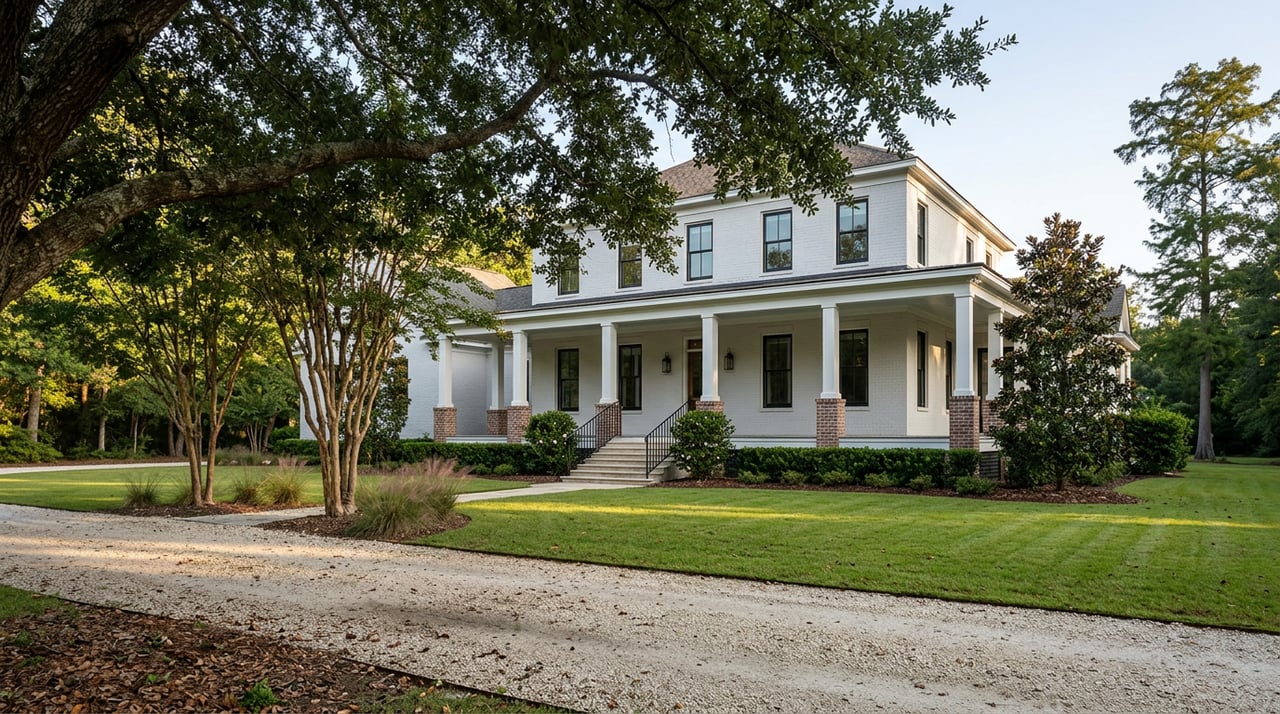
Two lots come up in the same week, both in The Sanctuary, both close to an acre, both priced within a few thousand dollars of each other. A buyer comparing them on price per acre would call it a coin flip. It isn't. One lot lets you hire any builder in Louisiana and start whenever you're ready. The other comes pre-attached to a single builder's inventory, meaning the construction timeline, the markup, and the finish-out choices are largely decided before you close.
That distinction, builder-restricted versus non-builder-restricted, shows up in almost every current listing for vacant land in The Sanctuary, and it matters more than the acreage or the asking price for one simple reason: the community is running out of lots to sell. What used to be a choice buyers could make casually is becoming the last real decision left to make in a neighborhood otherwise built out.
Two Listings, One Word Apart
Walk through the land listings active in The Sanctuary this summer and the pattern repeats. A 1.15-acre homesite backing to a protected preservation area is marketed explicitly as not builder restricted, meaning the buyer picks the builder and the schedule. A separate lot near the rear gate, offering access to the Causeway Bridge in under five minutes, is listed as part of Lakeshore Homes' inventory, meaning it comes bundled with that builder's construction process and pricing. A cul-de-sac lot at high elevation elsewhere in the neighborhood carries the same kind of attachment to H. Crosby Construction, sold as part of that company's building package. Meanwhile a parcel near the front of the subdivision, along the route of the neighborhood's Eve parade, is sold with complete architectural plans from SCNZ architects of New Orleans already attached, land surveys and plot planning done, and the buyer free to choose whoever builds it.
None of these differences show up in the price-per-acre math. They show up in the fine print, and they change what a buyer is actually purchasing.
What Builder Restricted Actually Locks In
A builder-restricted lot is part of a construction company's land package. The company controls the timeline, often builds to its own set of plans or a limited plan library, and the price you're quoted for the finished home includes that builder's margin without a competitive bid process. The Lakeshore Homes lot near the rear gate and the H. Crosby Construction lot on the high-elevation cul-de-sac both work this way: the buyer isn't choosing a contractor so much as buying into one that's already been chosen.
This isn't unusual for a builder-restricted arrangement, and it isn't automatically a bad deal. It can mean a faster path to groundbreaking, since the builder already knows the lot and the neighborhood's design standards. But it does mean the buyer gives up the leverage that comes from getting quotes from three or four builders and negotiating on scope, materials, and price.
What Non-Restricted Actually Buys You
A non-builder-restricted lot flips that arrangement. The buyer selects the general contractor, negotiates the contract independently, and sets the construction timeline around their own schedule rather than a builder's project queue. Several of the lots currently available in The Sanctuary are marketed on exactly this freedom, framed as the ability to tailor every detail to your vision and timeline.
Some of these lots come with a head start baked in. The lot along the Eve parade route includes finished architectural plans for a modern four-bedroom, five-bath home already designed by SCNZ architects of New Orleans, along with completed land surveys and plot planning, meaning a buyer could walk in with permitting-ready drawings and still choose any builder to execute them. That same range shows up in the acreage on the market right now, from just over an acre near the preservation area up to a nearly seven-acre parcel called The Preserve, sitting along more than 260 feet of Bayou Chinchuba frontage.
The tradeoff is that non-builder-restricted lots put more of the coordination burden on the buyer. There's no built-in construction partner. The buyer or the buyer's agent has to vet contractors, compare bids, and manage a process that a builder-restricted lot would have handled by default.
The Layer That Applies No Matter Which Lot You Choose
Whichever path a buyer takes, builder-restricted or not, the neighborhood's homeowners association still governs what gets built. The Sanctuary Homeowners Association, Inc. is registered at the community's own address on Sanctuary Boulevard in Mandeville, and design standards for new construction run through that association the same way they would for any gated, covenant-restricted neighborhood on the Northshore. A buyer working with an established builder already familiar with those standards has a smoother path through that layer. A buyer building independently is working out the association's expectations for the first time, on their own plans, without a builder who has already been through the process.
This means the real choice a buyer is making isn't whether they'll face design oversight. They will, either way. The choice is whether they navigate that oversight through a builder who already knows what the association expects, or independently, from scratch.
A Side-by-Side Look
| Builder-Restricted Lot | Non-Builder-Restricted Lot | |
|---|---|---|
| Who selects the builder | Locked to the lot's affiliated builder | Buyer's choice, open market |
| Construction timeline | Set by the builder's project queue | Set by the buyer and chosen contractor |
| Pricing leverage | Limited, builder's package pricing | Buyer can solicit competing bids |
| Design starting point | Often the builder's existing plan library | Sometimes includes pre-drawn custom plans, sometimes a blank slate |
| HOA design standards apply | Yes | Yes |
| Best fit for | Buyers who want a faster, more predictable path to groundbreaking | Buyers who want control over contractor selection and budget negotiation |
Why This Matters Now Rather Than Later
The Sanctuary spans roughly 1,170 acres and was platted for more than 400 homesites, most of which are long since built and occupied. What remains is a short list of vacant parcels, and the listing language across multiple current offerings uses the same phrasing: one of the last chances to build here, very few lots remaining, a rare opportunity to secure ground in a neighborhood that otherwise trades almost entirely in finished homes.
That scarcity is exactly why the builder-restricted distinction matters more this year than it would have a decade ago, when the developer was still releasing new phases and a buyer who didn't love the terms on one lot could simply wait for the next release. That flexibility is gone. Within a relatively short window, the remaining inventory of buildable land in The Sanctuary will be sold, and every future transaction here will involve an existing home rather than a choice between building paths. For a buyer who wants to build new behind these two gated entrances, in a community with a Health and Activity Center, tournament-size pool, tennis courts, and miles of walking trails, minutes from the Causeway Bridge and near Beau Chene Country Club, this is close to the last window to decide whether they want a builder chosen for them or the freedom to choose one themselves.
A Short FAQ
If I buy a builder-restricted lot, can I switch to a different builder later? Typically no. The restriction is usually tied to the land sale itself, meaning the affiliated builder has an agreement in place with the lot before it's marketed. A buyer who wants a different builder should be looking at non-builder-restricted inventory instead.
Does the homeowners association treat the two lot types differently? No. The Sanctuary Homeowners Association's design standards apply to every lot and every owner regardless of which builder is involved. A builder already familiar with the community may move through that process more efficiently, but the standard itself doesn't change.
Do the community amenities differ depending on which lot I buy? No. Gated access, the pool and fitness center, tennis courts, the ball field, and the walking trail network are shared amenities available to every homeowner in The Sanctuary, independent of whether the lot was builder-restricted or open to any contractor.
Buying raw ground in a neighborhood this close to full build-out is not the same transaction as buying an existing home, and the fine print on a lot listing carries more weight than it would almost anywhere else in the market. If you're weighing one of the last parcels in The Sanctuary, or comparing it against other Northshore land, Puddy Robinson can walk through what a specific lot's restrictions actually mean for your build before you're under contract. Let's Connect.
This article is general information, not legal, tax or financial advice. Consult a qualified professional about your situation.
