In the spring of 1956, two young men having lunch at the New Orleans Petroleum Club found they had each been looking at the same kind of land. They wanted a home in the country among the trees, possibly on a river, near where the new causeway across Lake Pontchartrain would come ashore. That conversation is how the local history blog Tammany Family begins its account of Tchefuncta Club Estates. That same year, on August 30, 1956, the original span of the Causeway opened to traffic, according to the American Society of Civil Engineers.
The bridge and the neighborhood have now both reached 70. Tchefuncta's future residents pooled their own money, made their own plans, and divided the land among themselves by drawing names from a hat. Seven decades later, the neighborhood still adds land the same way.
Fifty Dollars Toward an Option on "Emfred"
In June 1956 the small group found a wooded tract on the Tchefuncte River known as "Emfred." It was the country place of the Suter family of Bogalusa. The group needed $6,000 for an option, and the founders spent several days persuading friends to put in $50 apiece. Tammany Family preserves the slogan that came next:
"If 120 people put up $2000 each we can buy the property and put in roads."
The first plans were modest. Each owner would supply his own water and a septic tank. The group then called a meeting at the Petroleum Club, elected a board, and formed Tchefuncta Club Estates Inc. The tract ran to 900 acres along the river in the southeast section of Covington, near Madisonville and just south of what is now I-12. Lake EmFred, at the center of the community today, still carries the old place name. The association's history page says the lake is named for Fred and Emma Suter.
The founders worked unpaid, and many of them never fully enjoyed the result. Oil companies transferred their people. Of the original 15 on the organizing committee, only seven still lived in the community when the account was written.
Why the Roads Bend the Way They Do
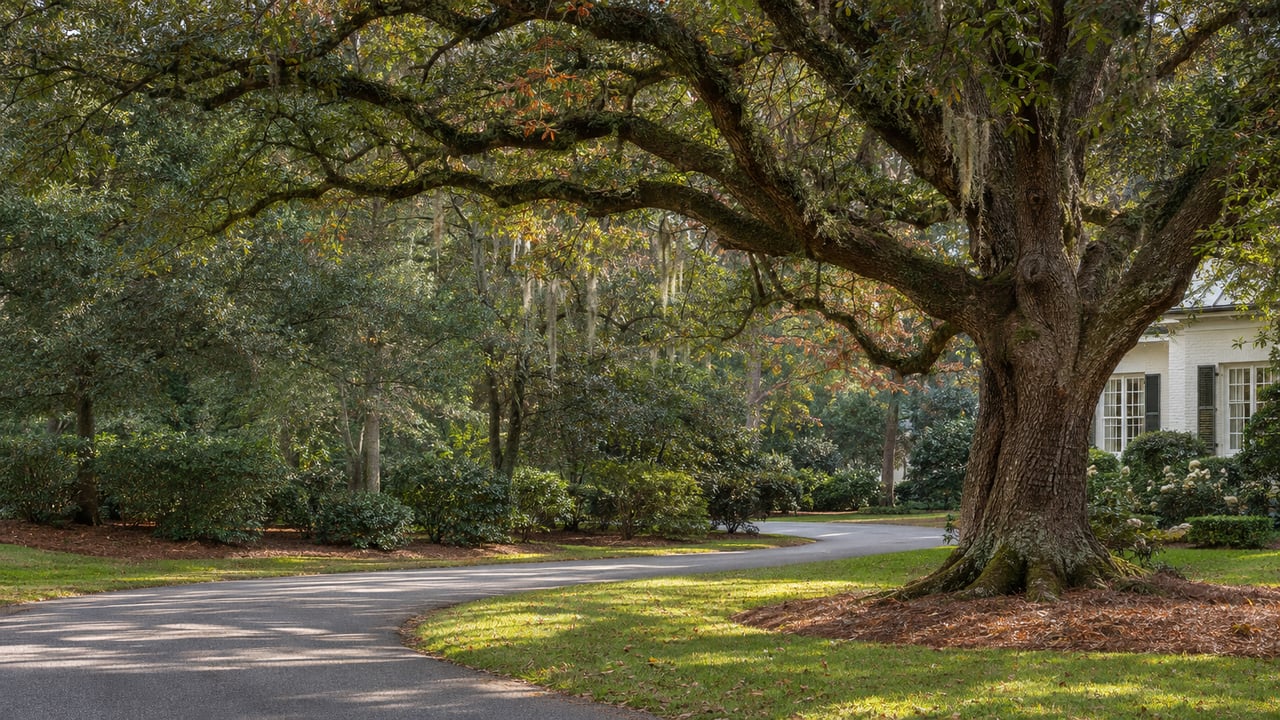
Tchefuncta's winding roads are the first thing anyone notices, and they had a price. Tammany Family says the founders hired a professional engineering firm and staffed committees from among the co-owners for roads, sewerage, water, utilities, and the country club. One committee existed only to name the streets. Along the way they learned why commercial developers prefer straight streets: every bend in a sewer line needs its own manhole, at real extra cost. They paid it anyway, so the roads you jog today follow the trees rather than a grid.
The same willingness to pay shows up underground. By 1959 the streets were finished and water, sewer, and power were in place. The association says those power lines were the first in the Deep South to be buried. The country club's own timeline lists the underground electric work alongside water, sewage, and roads in the earliest phase of construction.
The street-naming committee settled on birds, trees, and flowers, and that rule has never lapsed. When the newest section opened, New Orleans CityBusiness reported that its streets kept the tradition, with names that include:
- Thunderbird
- Calla Court
- Bright Leaf
- Silverberry
- Hibiscus
- Senna
Construction started in the fall of 1956, and so did the rain. Tammany Family says longtime residents remember 1957 through 1959 as the rainiest years on record. Many members moved to Covington, four miles away, to follow the progress. One family rented the old Suter home and lived through three years of mud to be close to the work.
Names From a Hat, Then and Since
When the land was ready, nobody bid for lots. The first 144 people who had joined the option drew names from a hat to set the order in which they chose sites. The next group, members 144 through 246, drew again. Families walked the woods looking for the spot they wanted, then picnicked under moss-hung trees or swam in the river. The association's history puts the original homeowners at 246.
That method has come back twice. In 2005 the neighborhood had 385 families, and growth was pressing in along Highway 21 and I-12. To buffer itself, the Estates bought 317 acres to the north from the Slaughter family heirs for $5.5 million. Hurricane Katrina struck two weeks after the purchase, and development waited two years. The next expansion came from the Johnston family. Their 240-acre tract next to Pinecrest on Highway 21, running south to Brady Island, had been discussed with the board since 2003. In 2018 the family offered Tchefuncta first right of refusal, and in 2019 the corporation matched the highest offer and bought it.
| Section | Land acquired | How the lots were assigned | Homes followed |
|---|---|---|---|
| T1 | Suter tract, 1956 | Names drawn from a hat, in two groups up to 246 | First resident, March 1960 |
| T2 | 317 acres from the Slaughter heirs, 2005 | Lot lottery among interested buyers, 2007 | First homes, 2009 |
| T3A | Johnston tract, 2019 | Lot lottery for 58 sites | Construction began 2021 |
Each time, the corporation built the roads, installed utilities, and held a drawing. The association describes T2 as 204 homesites with 45 acres still left in mature trees and wetlands. It describes T3 as one of the lowest-density developments in St. Tammany Parish, planned for 133 sites in total, with the remaining T3B lots to be created later. The association says families in all three sections are shareholders, and that some households are now on their third generation in Tchefuncta.
The Club Came Before the Houses
The 1956 group meant to finish the shared amenities before most people had a front door, and the order of construction shows it. The club's timeline marks 1960 as the year the first new home was built and the year Tchefuncta Country Club was established. In 1961 the clubhouse, pool, two tennis courts, and a nine-hole course opened, when the Estates had just 30 homes. The club opened on land leased to it by the Estates. The marina followed in 1964. The neighborhood reached 100 homes in 1965, and the course grew to 18 holes in 1969, the same year the second span of the Causeway opened.
Tammany Family's account lists what the founders had built by the early years: 11 miles of winding roads, wooded sites with a minimum of 150 by 200 feet, and 250 acres of club and recreation land. That land held a yacht harbor, boat ramp, horse stable, driving range, and an AAU-size pool. The association's description today is close. It counts more than 10 miles of private interior roads under a strictly enforced speed limit, used from early morning to dusk by walkers, dog owners, and cyclists.
Lake EmFred and the River the Founders Wanted
The founders wanted a home "possibly on a river," and the water is still where the neighborhood gathers. The association describes Lake EmFred as ringed with mature cypress, pine, oak, and sycamore. Its private park has picnic areas, a playground, two docks with seating, and a neighborhood boat launch with access to the Tchefuncte River. Residents fish from the banks and the dock and paddle the lake in canoes and kayaks. Boat owners use the marina near the Country Club, which has a fueling station and slips for both boats and jet skis.
The lake also hosts the fall "Break at the Lake," one of the traditions the association lists with the Fourth of July fireworks and golf cart parade and the Mardi Gras golf cart parade. The newest gathering place is the Pavilion in T3, set on open green space and used for concerts, charity fundraisers, and birthday parties. In 2024, donor gifts added a playground and a baseball diamond there. Along with Lake EmFred, the association names the historic red bus stops as landmarks.
A Seventieth December
The 1956 founders had a committee for street names, and their successors have a club for the season. The Tchefuncta Home and Garden Club gives the Garden of the Month award and runs the annual Christmas Decoration contest. It also keeps the Little Libraries near the Country Club and tennis courts stocked, with history among the subjects on the shelves. The Yule Y'all Christmas Market is another annual tradition. The association describes it as a gathering of vendors, artists, and craftsmen at Tchefuncta Country Club, held in time for holiday gift-giving and paired with a holiday luncheon.
For anyone planning beyond the gates, Covington's 12 Days of Christmas lighted displays run downtown from December 1, 2026, through January 6, 2027, lit from dusk to dawn. Christmas in Covington and the tree lighting take place Saturday, December 12, from 4 to 6:30 p.m. at the Covington Trailhead, 419 N. New Hampshire St. The Covington Heritage Foundation's History and Holly Tour of Homes follows on Sunday, December 13, from 2 to 5 p.m.
Seventy years after the Petroleum Club lunch, the Estates still adds land the way the founders did it: the corporation buys the tract, builds the roads, and holds a drawing for the lots. The remaining T3B lots will be created sometime in the future, and the T3 acreage along Highway 21 remains uncleared land.
If you would like to talk about your own place in Tchefuncta Club Estates, whether an original T1 lot or a newer build in T3, Puddy Robinson would be glad to hear from you. Let's Connect.
