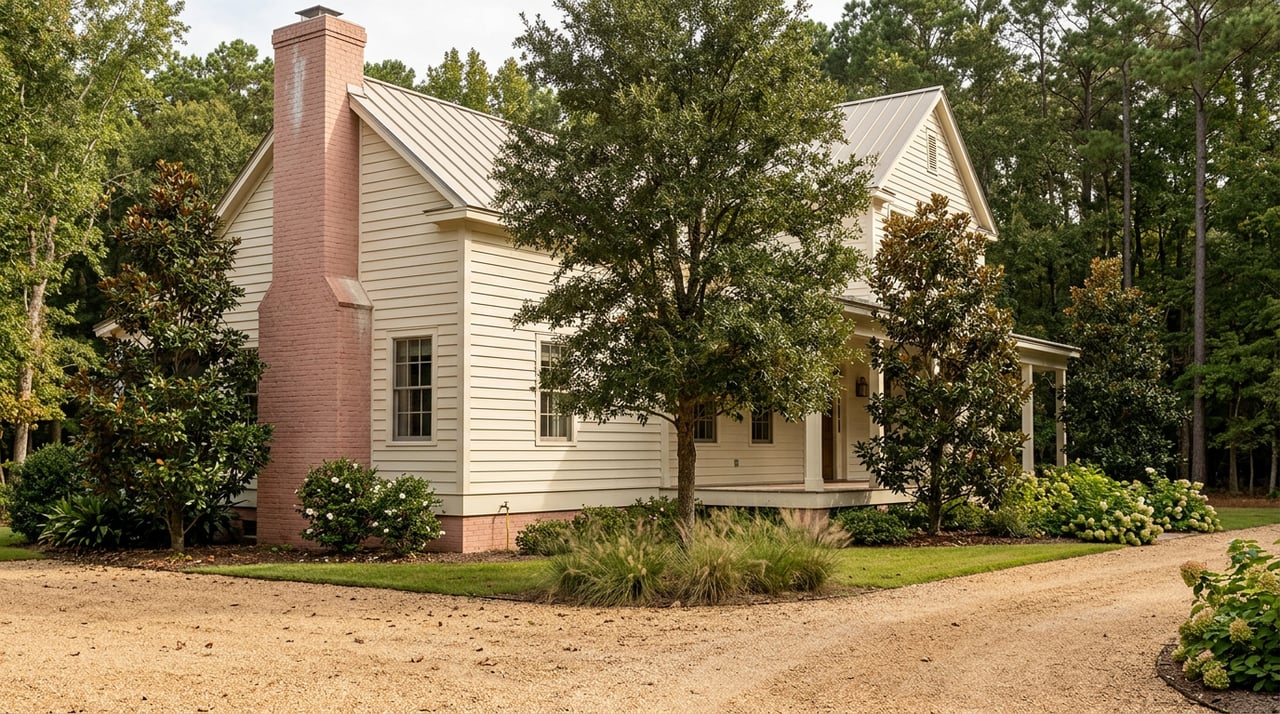
Two listings sit near the top of the same search. Both are five wooded acres north of Covington, both roughly the same asking price, both photographed under the same live oaks. One will let a buyer break ground in ninety days. The other will not let a buyer break ground at all.
The number on the listing did not tell you which was which. Nothing on the portal did. What separated them was a set of buildable-envelope facts that never appear in an MLS field: a percolation result, a septic setback geometry, a zoning district letter, and a FEMA flood zone line. On Northshore acreage, those four inputs price the parcel. The dollar figure only summarizes them.
The number that does the work is not the one on the listing
St. Tammany Parish has real depth in the land market. LandSearch shows roughly 413 land listings across the parish at an average of about $43,803 per listing-acre, while Acres.com puts the median sold price at closer to $12,488 per acre across 345 recorded sales. That spread is not a data error. It is what happens when a market prices raw acreage very differently once the buildable envelope on any given parcel has been drawn.
The listing figure is what sellers are asking for the land they hope to sell. The sold figure is what buyers have actually paid once the perc, the setbacks, the zoning, and the flood map got involved. Between those two numbers sits the entire due-diligence period, and that is where offers on Northshore acreage are won or lost.
| Two 5-acre tracts at the same asking price | Tract A | Tract B |
|---|---|---|
| Location cue | Merrywood, south of Folsom | Along the 1077 corridor toward I-12 |
| Zoning district under the UDC | L-1 Large Lot Residential | R-2 Rural Residential |
| Existing improvements | Well and septic in place from 2018 | Raw, no perc on file |
| FEMA flood zone | Zone C, high and dry | Split Zone A and C, wetlands per map |
| Practical result | Building pad located, permit path short | Perc pending, setback pending, house location uncertain |
Those two parcels are worth different amounts. The listings do not have to say so, because the mechanism that will price them is not visible until a buyer engages it.
The perc test is a pricing input, not a closing item
Louisiana Administrative Code Title 51, Part XIII sets out the requirements for individual sewerage systems on any parcel without central sewer. Tank sizing is keyed to daily design flow at 2.5 times the estimated load, with 500 gallons as the minimum for a one-bedroom residence. Multi-compartment tanks or tanks in series are permitted and encouraged. Setbacks from wells, water lines, and property lines are governed under Part XII.
Before any of that matters, the soil has to accept effluent at a workable rate. That is what a percolation test measures. In the Northshore's mix of loamy uplands, clayey pockets, and areas with a seasonally high water table, results can vary from one corner of a five-acre tract to another. Industry cost data as of mid-2026 puts a professional perc test in the $750 to $1,900 range, with a typical average near $1,300, plus a septic permit fee of a few hundred dollars once the test passes. If the parcel fails a conventional perc, the alternative is an engineered system, and those installations commonly run fifty to one hundred percent above a standard gravity system.
The point for a buyer is not the fee. The point is timing. A perc test needs to be scheduled, pre-soaked, dug, observed, and filed. A due-diligence window written for a suburban resale, ten to fourteen days, will not survive contact with a rural health department calendar. On a serious acreage offer, the perc contingency needs to be sized to the parish, not to the closing timeline the buyer would prefer.
The zoning letter on the listing decides the geometry of the house
St. Tammany Parish adopted the Unified Development Code as part of a comprehensive rezoning, and the current Code of Ordinances is codified through Ordinance No. 26-5906, enacted January 8, 2026. Chapter 400 of the UDC sets the residential districts a buyer will most commonly see on rural and semi-rural tracts:
- R-1 Rural Residential and R-2 Rural Residential anchor most low-density land north of Covington and around Folsom. Both permit single-family use and require individual sewer systems to meet Louisiana Department of Health standards when central sewer is absent.
- L-1 Large Lot Residential is the district a buyer sees when the parish or a prior owner has deliberately committed the parcel to larger, single-family use. On May 11, 2026, the St. Tammany Parish Planning and Zoning Commission agenda included a request to rezone 33.32 acres on the north side of Dove Park Road, east of Little Creek Lane in Mandeville, from R-2 to L-1. The petitioner on that agenda was the parish government itself.
- S-1 and S-2 Suburban Residential appear closer to the incorporated towns and along the growth corridors.
The relevance for a buyer is straightforward. Two neighboring five-acre tracts under different district labels do not carry the same permitted uses, the same minimum lot geometry, or the same setback constraints. A parcel inside a PUD overlay behaves differently again. The same May 2026 P&Z agenda included a major amendment to the Bedico Creek Preserve PUD on the northwest side of LA Highway 1085 and Bedico Parkway in Madisonville, which is the kind of item that shifts what a nearby lot can and cannot do without ever changing the asking price of that lot.
Louisiana Revised Statutes 33:106.1 layers on a further constraint for any unincorporated subdivision relying on septic. It sets a minimum lot size of 22,500 square feet with 125 feet of frontage, subject to the parcel being able to support both the sewage disposal system and an individual water system to state health standards. A five-acre listing carved out of a larger tract may be legally divisible on paper and still not deliver five separately buildable envelopes once the statute is applied.
The setback envelope no one draws on the listing photo
A well and a septic system have to share the parcel with the house, the driveway, and the property lines. Louisiana health regulations require minimum distances between the septic tank, drain field, and any water well or water line, generally starting at fifty to one hundred feet depending on the specific fixture and adjacent uses. The drain field itself is not a small thing. A conventional system for a three-to-four-bedroom home typically needs on the order of ten thousand square feet of suitable soil, plus a reserve area for future replacement.
On a wooded five-acre tract with a stream frontage, a wetland edge, a driveway easement, and a preferred house site under the mature oaks, that setback envelope can eliminate large portions of the parcel from consideration. It is common for the site that photographed best in the listing to be the one site the drain field cannot serve.
The order of operations that protects the buyer is old-fashioned. Walk the parcel with a soil evaluator before the offer, or write the offer to permit that walk during due diligence. Confirm the well location the seller has in mind, or the well location the buyer will drill. Draw the septic envelope on a survey, not on a photograph.
The flood zone line is a build-cost line
Northshore listings routinely publish flood zone letters directly in the marketing copy because sellers know the letters do work. A four-acre parcel south of Folsom advertised as "entirely FLOOD ZONE C" is not making a lifestyle statement. It is telling a builder the pad elevation, the foundation type, and the insurance quote will look one way rather than another. A thirty-acre tract described as "flood zone A and C" is telling the same builder that half of the parcel carries a different construction cost basis.
UDC Chapter 400 requires that any construction or land alteration within a FEMA-designated 100-year flood zone go through the Parish Engineer before a building permit is issued. That is a real step, not a formality. It affects the calendar and, in some cases, the design.
A due-diligence sequence for a serious acreage offer
The offer is where the buyer purchases optionality. On Northshore acreage, that means writing contingencies that match the parish's actual pace rather than the pace of a suburban resale.
- Confirm the current UDC zoning district and any overlay on the parish GIS before the offer is signed.
- Extend the inspection period to accommodate a licensed perc test, including pre-soak time, and a formal soil evaluation by a licensed soil scientist or engineer.
- Request any existing well logs, prior perc results, and prior septic permits from the seller in writing.
- Order a survey that locates the proposed house pad, the drain-field envelope with reserve area, and the well site under LDH setbacks.
- Pull the current FEMA flood map for the parcel and confirm whether any portion of the intended building footprint sits inside the 100-year zone.
- If the parcel sits inside a PUD or is affected by a pending rezoning on a P&Z agenda, request the file number and review the proposed amendment before removing contingencies.
None of these steps changes the asking price. All of them change what that asking price is really paying for.
The acreage market on the Northshore rewards buyers who ask better questions than the listing sheet answers. If you are weighing a specific tract north of Covington, around Folsom, or along the Madisonville corridor and would like a second read on the buildable envelope before you write an offer, Puddy Robinson is glad to walk it with you. Let's Connect.
